

Monkey embryoids created and implanted within the uterus from stem cells – Muricas News
 Monkey embryoids created and implanted within the uterus from stem cells – Muricas News
[ad_1]
Monkey embryoids created and implanted within the uterus from stem cells – Muricas News
[ad_1]
Human embryo growth and early organ formation stay underexplored matters attributable to moral points surrounding the usage of embryos for analysis, in addition to the restricted availability of supplies for his or her examine.
Now, Chinese language researchers have succeeded in creating buildings just like macaque embryos from embryonic stem cells for the primary time. As well as, they've managed to implant themselves within the uterus of feminine macaques and develop a hormonal response just like that of a being pregnant, though they've solely survived for a couple of week. In response to the authors, whose analysis is revealed in “Cell Stem Cell”, these fashions may serve to enhance information about embryonic growth and to research the causes of some early abortions.
However, as Antonio Urries, director of the Assisted Replica Unit of the Quirónsalud Hospital in Zaragoza and president of the Affiliation for the Examine of Reproductive Biology (ASEBIR), warns, these will not be embryos per se, “however” embryoid buildings »able to behaving like an embryo in its first days of growth».
And, because the researchers stress, the examine has not resulted within the beginning of any macaque infants. As a result of, as Luís Montoliu, a researcher on the Nationwide Middle for Biotechnology (CNB-CSIC) and at CIBERER-ISCIII, factors out, in statements to the Science Media Centre, it's about «an experiment that can't be carried out on people, because of the related technical, authorized, and moral limitations», though he acknowledges that research like this one, carried out in macaques, steadily carry us nearer to this chance. “The beginning of non-human primates derived totally from embryonic pluripotent stem cells grown within the laboratory is getting nearer and nearer with out the necessity to undergo the fertilization of an egg by a sperm, as has been attainable for years in mice.”
In the mean time, acknowledges examine creator Zhen Liu, from the Chinese language Academy of Sciences (CAS) in Shanghai, “the molecular mechanisms of human embryogenesis and organogenesis will not be very clear.” And since monkeys are evolutionarily carefully associated to people, “we hope that finding out these fashions will deepen our understanding of human embryonic growth, even make clear a number of the causes of early miscarriage.”
The work, factors out Alfonso Martínez Arias, ICREA analysis professor and researcher in Bioengineering Methods-MELIS at Pompeu Fabra College, is an extra step within the characterization of those growth fashions primarily based on embryonic stem cells and there might be others. Its worth, he factors out to SMC, will depend upon two issues: “reproducibility and the demonstration of its scientific worth in offering new information. The latter is, for the second, far-off. Macaques and people are completely different, even in the best way that blastocysts implant.”
Martínez Arias sees this work as an proof of idea that it will likely be a problem to breed attributable to the price of the analysis – working with primates will not be straightforward or reasonably priced – “however it's clearly proof that blastoids might be, are, a great tool to review the primary steps of uterine implantation, which have an effect on many points of infertility.”
What the Chinese language researchers have achieved is to engineer an embryo-like system that may be induced and cultured indefinitely, explains co-author Quian Solar. “It supplies new instruments and insights for the additional exploration of primate embryos and reproductive well being.”
The beginning of non-human primates derived from embryonic cells grown within the laboratory is getting nearer
Luis Montoliu
CNB-CSIC and CIBERER-ISCIII
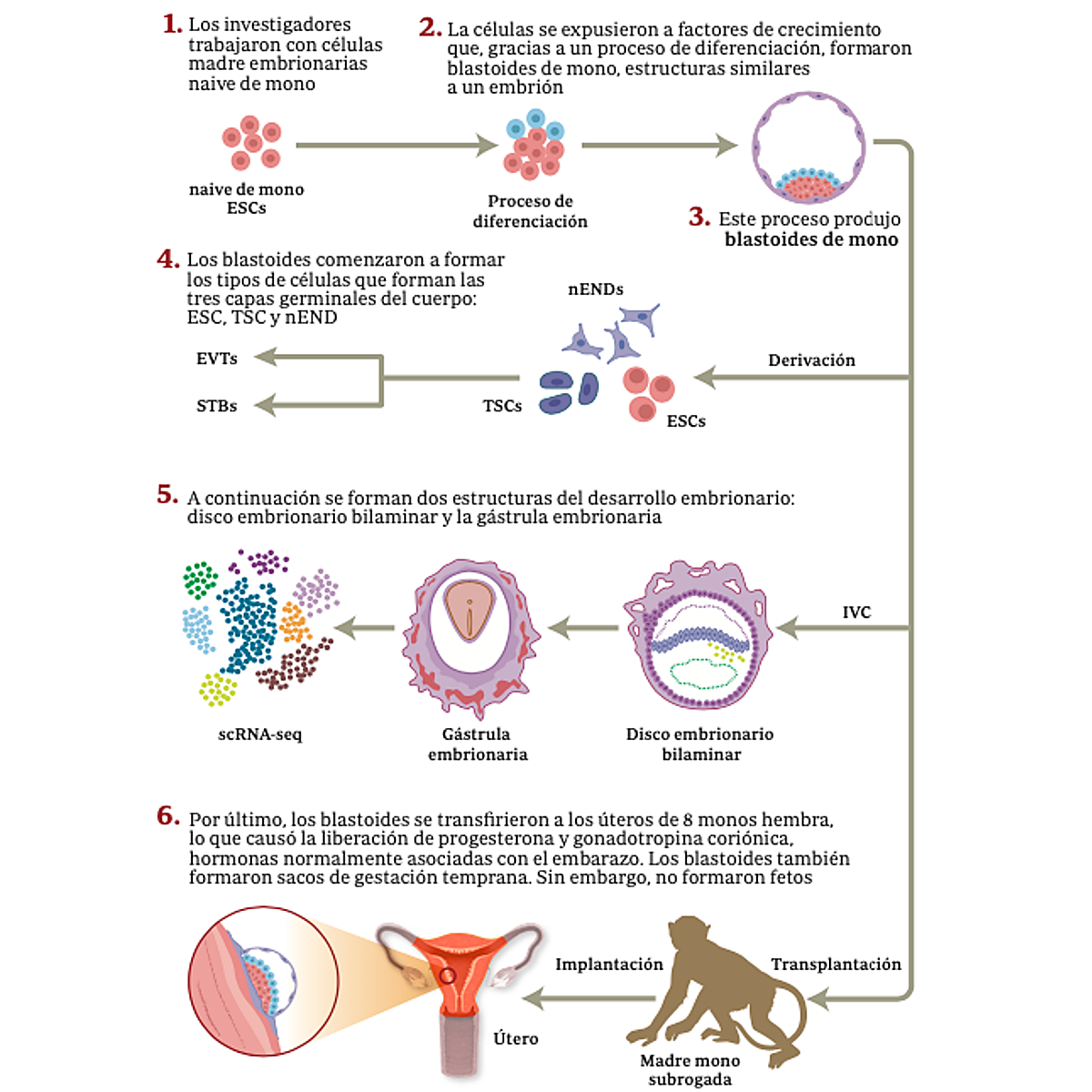
The researchers began with macaque embryonic stem cells, which they uncovered to a sequence of progress elements in cell tradition. These elements induced stem cells to kind embryo-like buildings for the primary time utilizing non-human primate cells.
They then noticed that the embryonic buildings, additionally known as blastoidesintroduced a morphology just like that of pure blastocysts.
Martínez Arias explains that from a structural standpoint (genes expressed by their cells), blastoids are virtually equivalent to their pure counterparts, blastocysts. «What the blastocyst does is implant itself within the uterus and, as soon as nicely established, start the development of the organism with the method of gastrulation: the technology of the seeds of every tissue and organ whereas they're organized in house. Till now there was no proof that blastoids may implant appropriately and provoke embryo growth. Within the case of people, for apparent moral causess».
In analysis, because the blastoids developed in vitro, they fashioned amnion- and yolk-sac-like buildings. As well as, in addition they started to kind the forms of cells that may finally make up the three germ layers of the physique.
Implanted within the uterus
The blasts have been then transferred to the uteri of 8 feminine monkeys; in 3 of the 8, the buildings have been implanted. This implantation resulted within the launch of progesterone and chorionic gonadotropin, hormones usually related to being pregnant. The blastoids additionally fashioned early gestation sacs, fluid-filled buildings that develop early in being pregnant to surround an embryo and amniotic fluid. Nevertheless, they didn't kind fetuses and the buildings disappeared after every week.
The researchers acknowledge the moral issues surrounding such a analysis, however stress that many variations stay between these embryo-like buildings and pure blastocysts. And what's extra necessary, the embryonic buildings do not need full potential for growth.
Urries recollects that even though these kind of embryoid buildings have already been efficiently generated in people with morphology and buildings just like pure embryos, their cultivation past day 14 or their implantation within the uterus of a lady will not be allowed. attributable to moral points.

The method has nice potential for the longer term and really promising applicability in people.
Anthony Urries
Director of the Assisted Replica Unit of the Quirónsalud Hospital in Zaragoza and president of ASEBIR
For that reason, he factors out to SMC, “with the ability to do such a analysis in a species so carefully associated to ours because the macaque monkeys is a preferrred mannequin for the examine intimately of the primary phases of organ growth as very important to mammals as are the guts, mind or neural tube».
Alternatively, he continues, “it may well assist us delve into sure implantation mechanisms and perceive why pregnancies fail, detecting these anomalies that may trigger abortions. Likewise, it may well information us within the growth of “artificial” organs and tissues for transplants and uncover the origin of some ailments”.
And, he provides, though it has the restrictions of being a way in a really preliminary part, the results of a really sophisticated and inefficient course of (round 25%), it has “nice potential for the longer term and really hopeful applicability in people.”
In future work, the researchers plan to deal with additional creating the embryo-like construction tradition system from monkey cells. «This can present us with a helpful mannequin for future research.says co-author Fan Zhou of Tsinghua College. “Additional software of monkey blasts could assist dissect the molecular mechanisms of primate embryonic growth.”
[ad_2]


0 comments: